


Simultaneous Construction Work: Maintaining Site Access During Dipole Leak Detection
Geomembrane cover systems are often installed in several stages. A first layer of protective sand or drainage stone is placed over the liner, sometimes followed by a separation geotextile, topsoil or other materials required for the project.
To ensure the quality of a dipole leak detection survey, testing must be performed on the first homogeneous layer installed directly above the geomembrane. Complete electrical isolation must also be maintained around the perimeter of the survey area.
This requirement normally means temporarily isolating the access roads. However, access-road isolation can become a challenge when the contractor must continue transporting materials and heavy equipment into the lined area during the geomembrane leak detection survey.
Combining Vehicle Access With Dipole Leak Detection
At first, maintaining construction traffic and performing dipole testing may appear incompatible. However, a temporary electrical isolation system can be installed across an access road, allowing the survey to continue without completely stopping vehicle traffic.
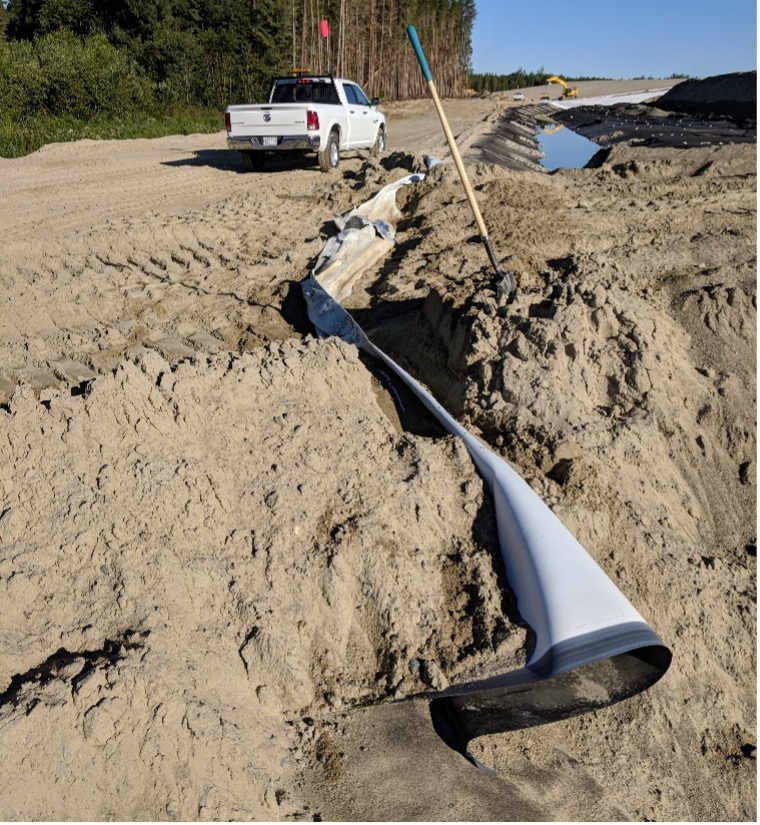
This solution requires the contractor’s cooperation. A trench must first be excavated across the access road near the top of the geomembrane slope. The excavation must extend down to the protective geotextile while avoiding damage to the existing geosynthetic components.
Installing a Temporary Electrical Barrier
A strip of sacrificial geomembrane is then installed vertically against one side of the excavation. The trench can subsequently be backfilled to restore the access road and allow construction vehicles to cross the isolated section.
As much sacrificial geomembrane as possible should extend beyond both sides of the road. This configuration creates an electrical barrier that limits the flow of current toward an external ground connection outside the survey area.
If the access road is not properly isolated, electrical current may bypass the area being tested. This current leakage reduces test sensitivity and can make it more difficult to locate defects in the geomembrane accurately.
Contractor Cooperation Is Essential
Temporary access-road isolation cannot be completed effectively without the contractor’s support. Excavating the road, installing the sacrificial geomembrane and backfilling the trench must be coordinated with ongoing construction activities and equipment traffic.
On one large-scale project, five access roads were electrically isolated while a dipole geomembrane leak detection survey was underway. With the contractor’s cooperation, cover placement, vehicle traffic and dipole testing continued simultaneously without major disruption.
Effective coordination therefore makes it possible to maintain construction progress while preserving the electrical conditions required for reliable geomembrane leak detection.
